Financial Wealth Indonesia
Building Interconnected Regional Ecosystems Toward a Smarter Indonesia
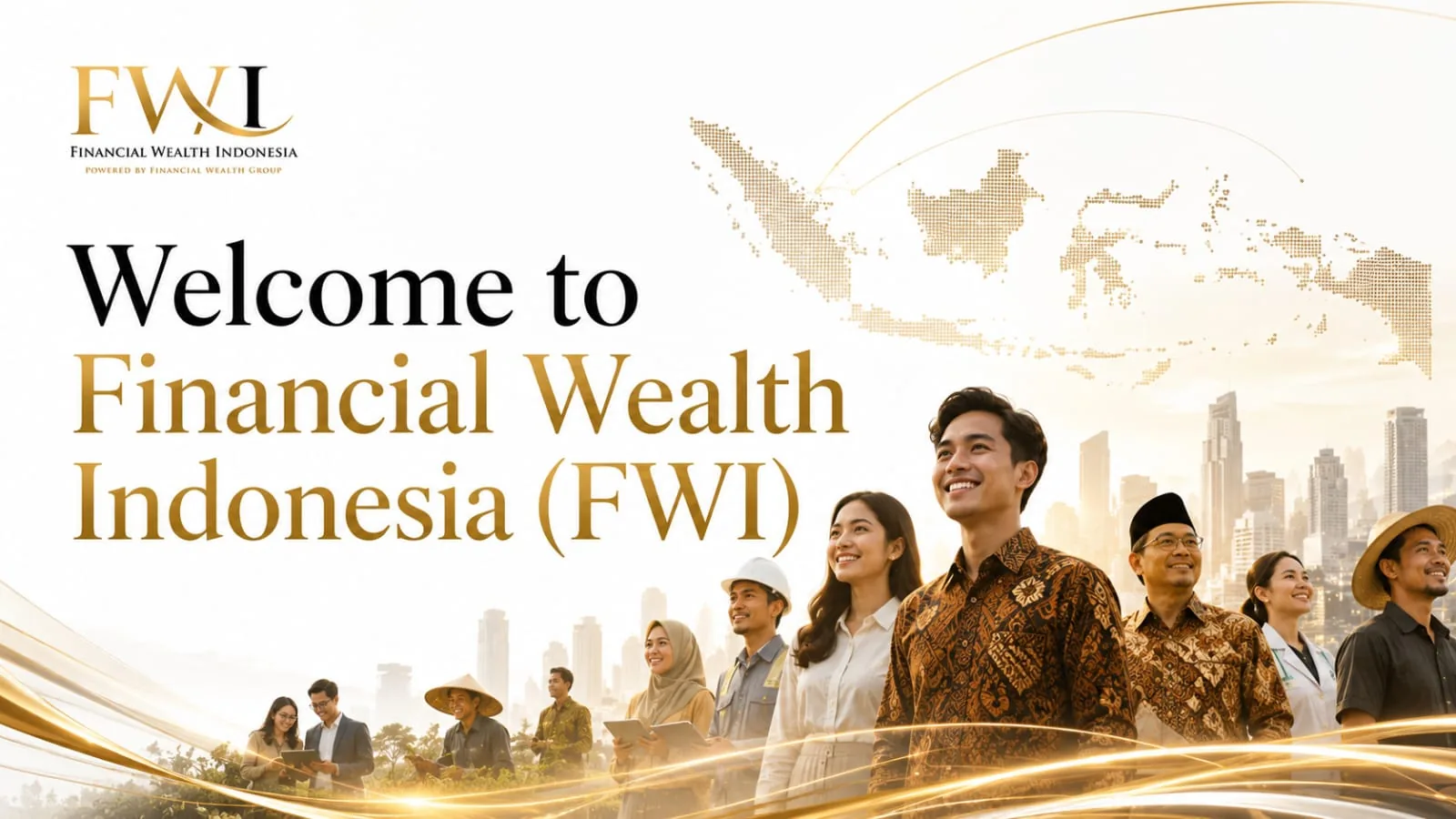
Financial Wealth Indonesia (FWI) is an ecosystem orchestrator focused on supporting the development of interconnected regional ecosystems across Indonesia. As part of Financial Wealth Group’s global ecosystem architecture, FWI integrates regional governments, financial infrastructure, digital ecosystems, communities, and regional economies into a collaborative operational framework designed to support long-term national transformation. We believe the future of Indonesia will not be shaped by isolated systems operating independently. It will be shaped by how intelligently ecosystems, regions, institutions, and communities are connected.
To bring this vision to life, FWI works as a bridge between strategy and execution— connecting policy intent with tangible outcomes. We convene stakeholders across provinces, cities, and districts to align priorities, share measurable progress, and reduce fragmentation across programs, platforms, and funding mechanisms. Through shared governance and transparent orchestration, we help ensure that regional initiatives reinforce one another rather than compete.
Our approach emphasizes three interconnected foundations. First, we strengthen financial infrastructure so economic activity can flow more reliably—from payment rails to credit access and risk management. Second, we accelerate digital ecosystem adoption that makes services discoverable, interoperable, and usable for both individuals and businesses. Third, we activate community participation to ensure adoption is grounded in real needs, local capability, and inclusive opportunities.
In every region, FWI maps existing assets and identifies where connectivity will unlock the next stage of growth. We then co-design implementation roadmaps with clear roles for government, industry, and communities—supported by data-driven monitoring that keeps long-term transformation on track. By connecting the right actors with the right incentives, we enable ecosystems to compound value over time.
This is how Financial Wealth Indonesia transforms networks into results—so Indonesia’s future is built not only with stronger institutions, but with smarter connections across every region. As ecosystems mature, we also focus on resilience— so regional development can withstand shocks and adapt to changing conditions. That means designing interoperability standards, establishing continuity plans for critical services, and building capabilities that remain effective even as technology and market dynamics evolve. We prioritize trust: trust in data, trust in processes, and trust in collaboration.
FWI’s ecosystem orchestration is reflected in practical programs that link local demand with regional supply. We support partnerships that expand access to affordable finance, strengthen SMEs through connected value chains, and improve inclusion through tailored digital and financial services. We also create spaces for knowledge exchange, allowing regions to learn from one another’s successes and accelerate adoption of proven playbooks.
Collaboration does not stop at implementation. We help establish long-term operating models that allow regions to sustain momentum—through shared metrics, continuous stakeholder alignment, and iterative improvements based on field feedback. This ensures that ecosystem connectivity translates into consistent benefits: more jobs, better livelihoods, and stronger regional competitiveness.
Ultimately, Financial Wealth Indonesia exists to make transformation practical. By orchestrating interconnected regional ecosystems with disciplined execution and shared accountability, we help Indonesia move toward a future where growth is distributed, systems are interoperable, and opportunities reach every community.
TOWARD A SMARTER NATION
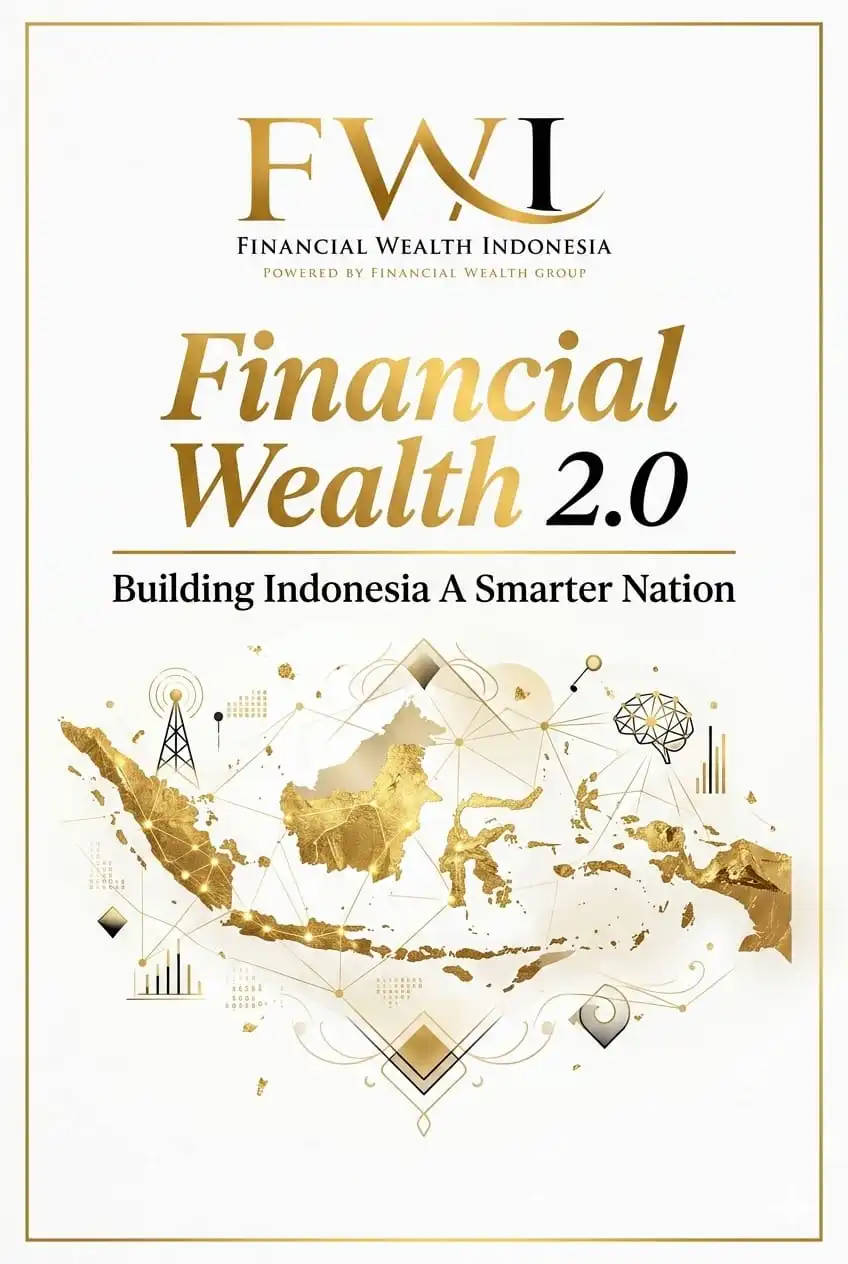
FWI believes the evolution toward a smarter nation begins at the regional level. Through Smart Cities, Smart Regencies, integrated digital participation, financial infrastructure, ecosystem intelligence, and collaborative regional development, FWI supports the creation of sustainable operational ecosystems capable of accelerating regional growth and long-term national progress.
Rather than focusing solely on digitalization, FWI emphasizes ecosystem orchestration — connecting infrastructure, participation, communities, and regional economies into one integrated movement.
Because a smarter nation is not built only through technology. It is built through connected ecosystems capable of moving together sustainably.
FWI also believes that the value of an integrated regional ecosystem must be measurable, trusted, and inclusive. That means clear governance frameworks, interoperable standards, and data integrity that strengthen public confidence. It also means ensuring that every layer of society can participate—so that innovation is not limited to cities, but spreads through villages, districts, and border regions with equal access to opportunities.
In practice, this requires FWI to work alongside local governments, industry, academia, and communities to design roadmaps that connect the dots: from mobility and energy to health, education, and resilient livelihoods. We encourage regional “digital-public utilities” that reduce duplication, streamline services, and enable faster decision-making—without compromising privacy, security, or sovereignty.
FWI’s ecosystem orchestration approach is anchored in long-term capability building. We help regions develop talent, establish collaboration mechanisms, and run iterative pilots that evolve into scalable programs. By aligning incentives, connecting systems, and strengthening local ownership, FWI supports growth that endures— creating the conditions for a smarter nation to rise, region by region, with resilience at its core.
AN ECOSYSTEM MOVEMENT
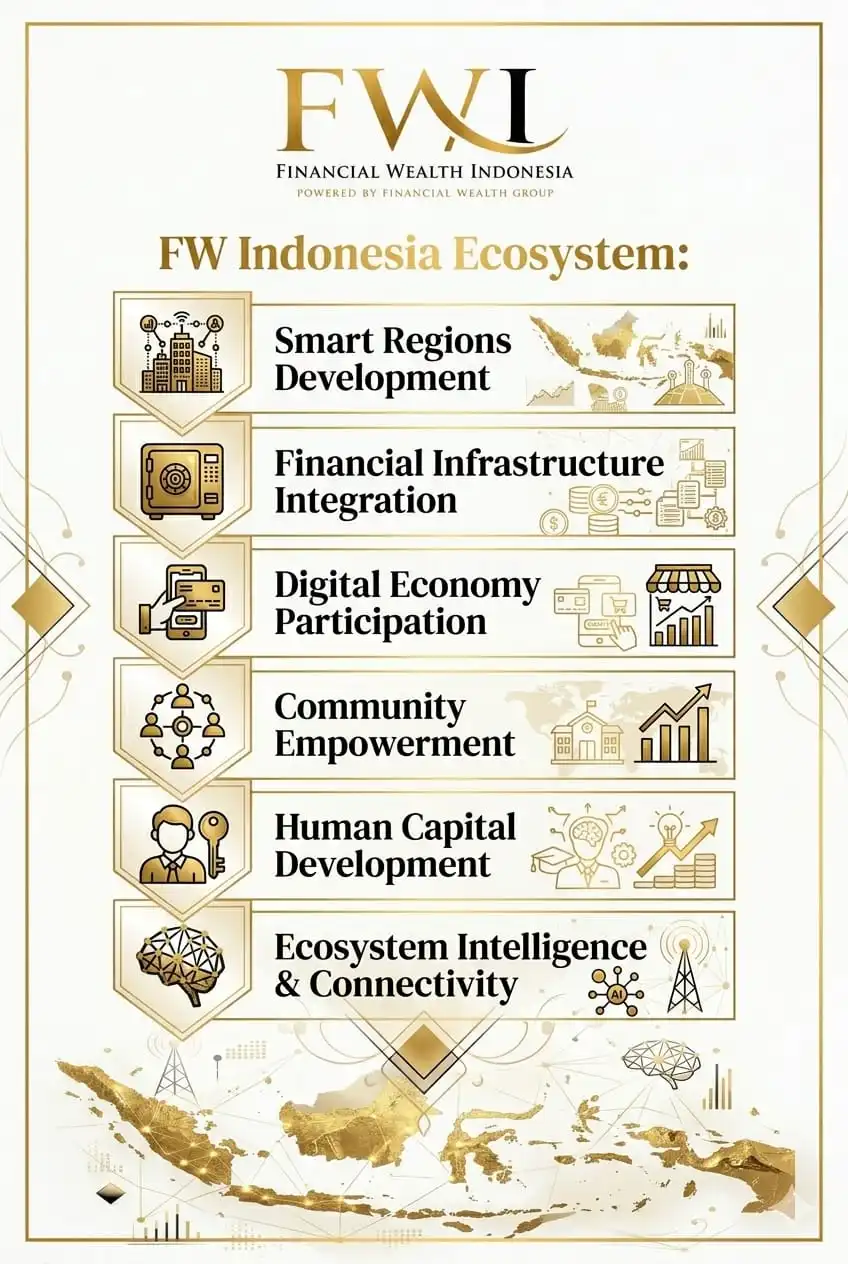
FWI is designed as more than a technology platform. It functions as a long-term ecosystem movement that brings together governments, industry stakeholders, communities, and digital innovators to collaborate on sustainable regional progress. In this way, FWI helps translate technology into real-world impact, rather than treating it as a standalone tool.
It is a long-term ecosystem movement focused on:
Smart Regions Development
supporting regions in building smarter urban and rural systems through data-driven planning, efficient public services, and connected infrastructure—so cities and regencies can respond faster to citizens’ needs. For example, this can include enabling integrated mobility and service platforms that reduce friction for residents and businesses.
Financial Infrastructure Integration
strengthening the foundation for financial access by connecting payment rails, digital onboarding, and micro-to-mid enterprise financing pathways. This may include supporting interoperable systems for merchants and SMEs so they can participate in broader economic value chains.
Digital Economy Participation
encouraging individuals and organizations to join the digital economy by improving digital readiness, market access, and e-commerce enablement. As an example, local producers can be supported to reach wider customers through digital channels and logistics coordination.
Community Empowerment
placing communities at the center through capacity-building, local leadership engagement, and tools that increase participation and transparency. For instance, community-driven initiatives can help ensure digital benefits reach underserved groups.
Human Capital Development
investing in skills and readiness for future work through training, mentoring, and workforce enablement programs aligned with regional economic needs. This can include digital literacy and job-readiness pathways for youth and professionals.
Ecosystem Intelligence & Connectivity
enhancing ecosystem awareness and coordination using analytics, connectivity frameworks, and cross-sector collaboration. This helps regions make better decisions, identify opportunities, and improve how stakeholders coordinate across regions.
Through collaborative ecosystem participation, FWI aims to help regions strengthen inclusion, accelerate economic participation, and support more connected regional growth across Indonesia. Ultimately, FWI supports the emergence of resilient, inclusive, and digitally empowered regions—where technology, finance, people, and infrastructure move forward together in a sustained ecosystem journey.
OUR BELIEF
We believe TOWARD A SMARTER INDONESIA
Indonesia does not need to become another country.
Indonesia needs to become a smarter version of itself.
The future of Indonesia may not be built by isolated systems.
It may be built by interconnected regional ecosystems capable of growing together intelligently, inclusively, and sustainably.
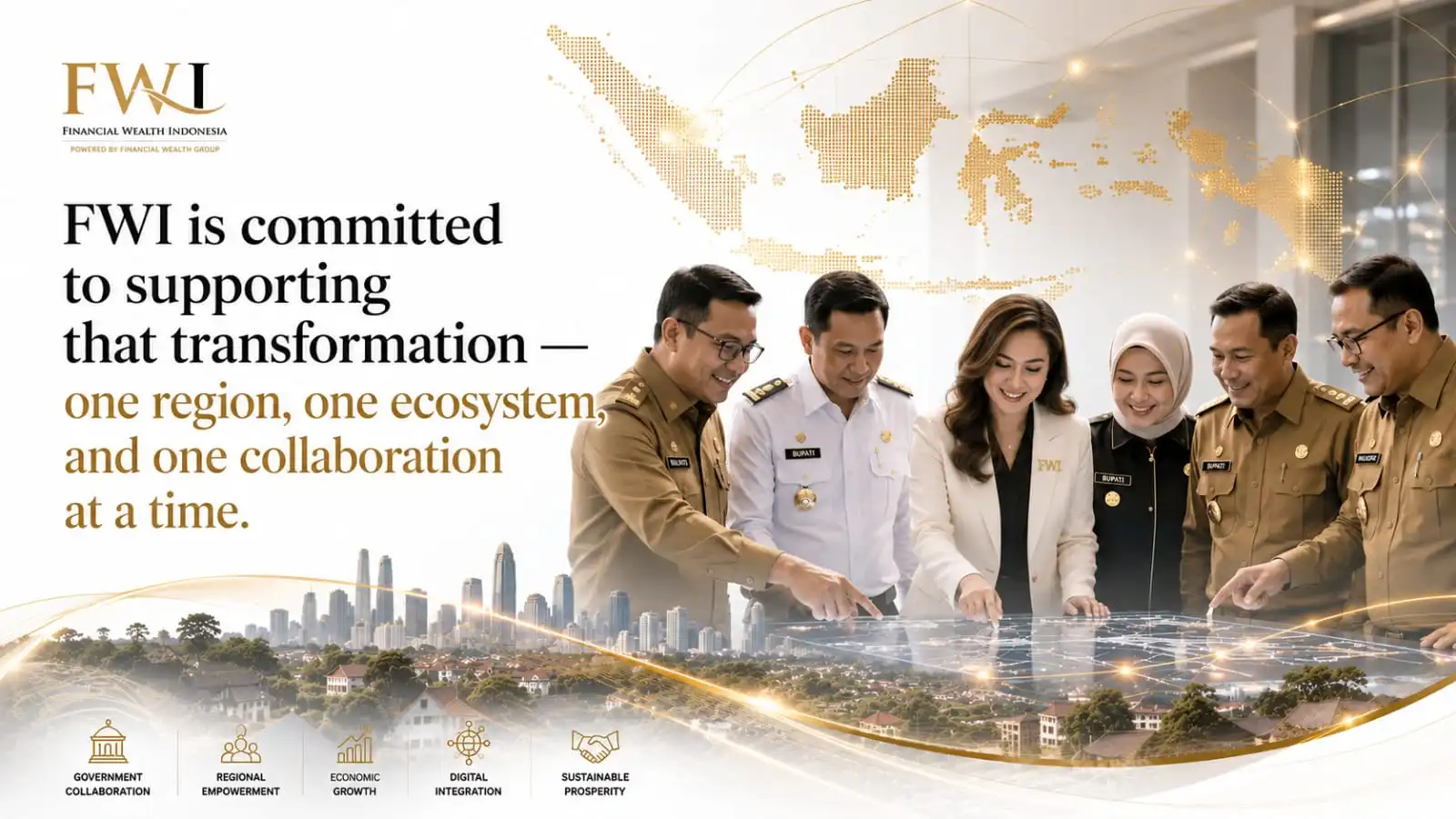
FWI is committed to supporting that transformation — one region, one ecosystem, and one collaboration at a time.
We believe smarter systems start with smarter communities. When regional partners share data, insights, and resources, progress becomes measurable—and momentum becomes collective.
We believe in decision-making that is evidence-driven, locally grounded, and designed to work in real conditions. Because a smart Indonesia isn’t only about technology.
It’s about people, institutions, and environments moving in the same direction. We believe regional collaboration can strengthen resilience.
From upstream watershed protection to downstream industry efficiency, every link in the ecosystem matters. From climate adaptation to disaster readiness, integrated planning can reduce risk and improve quality of life.
From workforce development to innovation networks, connected ecosystems can create opportunity—especially for those too often left behind.
We believe sustainability is not a slogan. It is a practice: cleaner energy, responsible land use, circular supply chains, and transparent governance.
It is the ability to grow today without compromising tomorrow. And it is achieved through partnership—academia, industry, government, and civil society—working as one.
FWI will keep fostering collaboration that scales.
By turning regional challenges into shared priorities.
By enabling interoperable systems that learn over time.
By supporting pilots, partnerships, and pathways that can be replicated across Indonesia.
One collaboration at a time—until smarter becomes the norm.
THE INDONESIA CHALLENGE
Indonesia is one of the world’s largest and most dynamic economies. Yet across regions, many systems still operate independently:
fragmented digital infrastructure
disconnected economic ecosystems
limited regional integration
uneven digital participation
and constrained regional operating capacity.
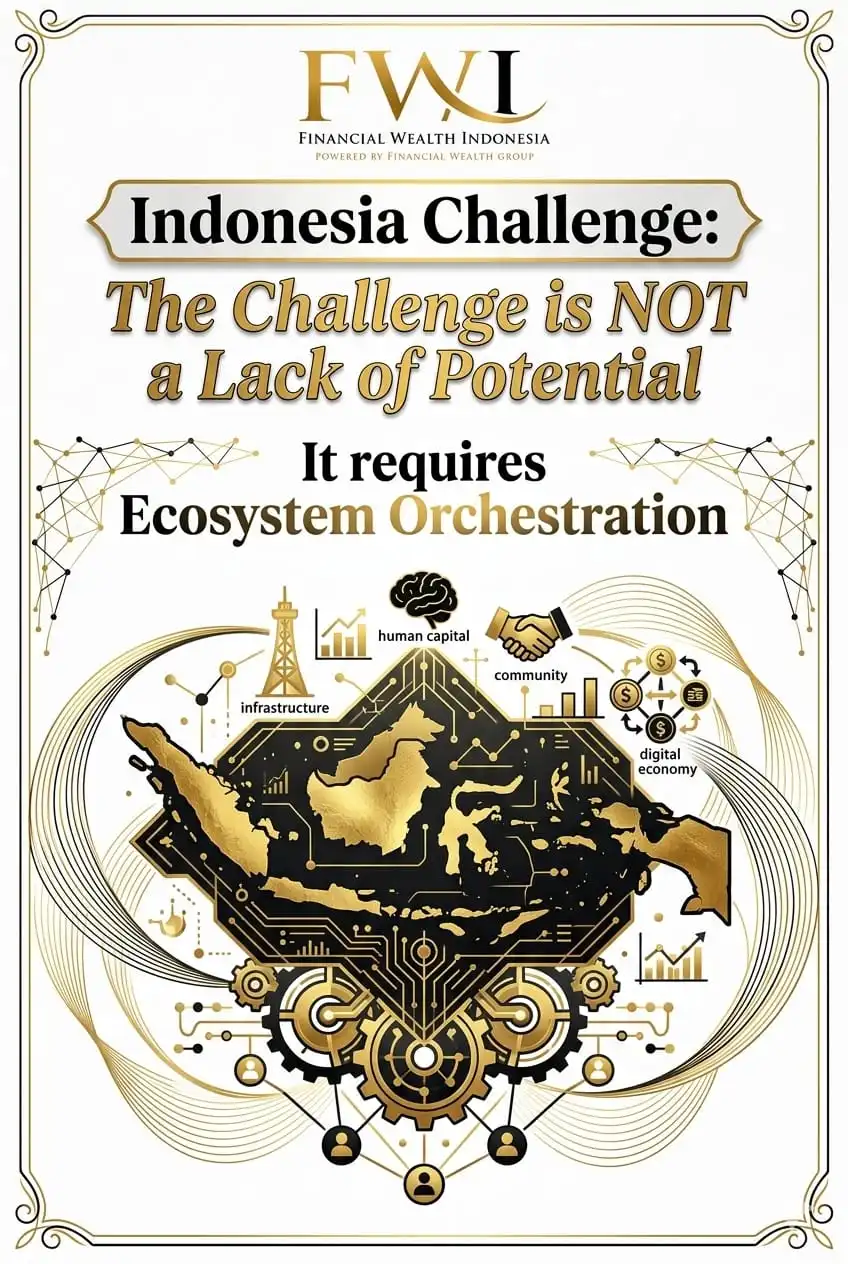
The challenge is not a lack of potential.
The challenge is the absence of integrated ecosystem infrastructure capable of connecting governments, financial institutions, communities, and regional economies into one sustainable movement.
FWI believes future regional growth requires more than digitalization.
It requires ecosystem orchestration.
To orchestrate that ecosystem, Indonesia needs a shared architecture—one that standardizes how data moves, how services connect, and how trust is established across borders and agencies.
This means interoperability by design, not as an afterthought: common protocols for identity, payments, and public services; interoperable platforms for SMEs and communities; and secure, auditable channels that enable responsible innovation.
It also requires orchestration of incentives.
When digital tools are deployed without shared outcomes, adoption stays uneven and value remains siloed.
FWI’s approach focuses on aligning government priorities, financial access, and community capability into measurable pathways—so regional programs move from pilots to platforms, from platforms to scale, and from scale to sustainability.
The ecosystem must be anchored in practical operating capacity.
That includes capability building for regional operators, a governance model for collaboration, and funding mechanisms that reward integration—not fragmentation.
With the right orchestration layer, Indonesia can transform regional momentum into long-term economic resilience and inclusive growth.
ECOSYSTEM ARCHITECTURE
FWI connects multiple ecosystem layers into one integrated regional framework.
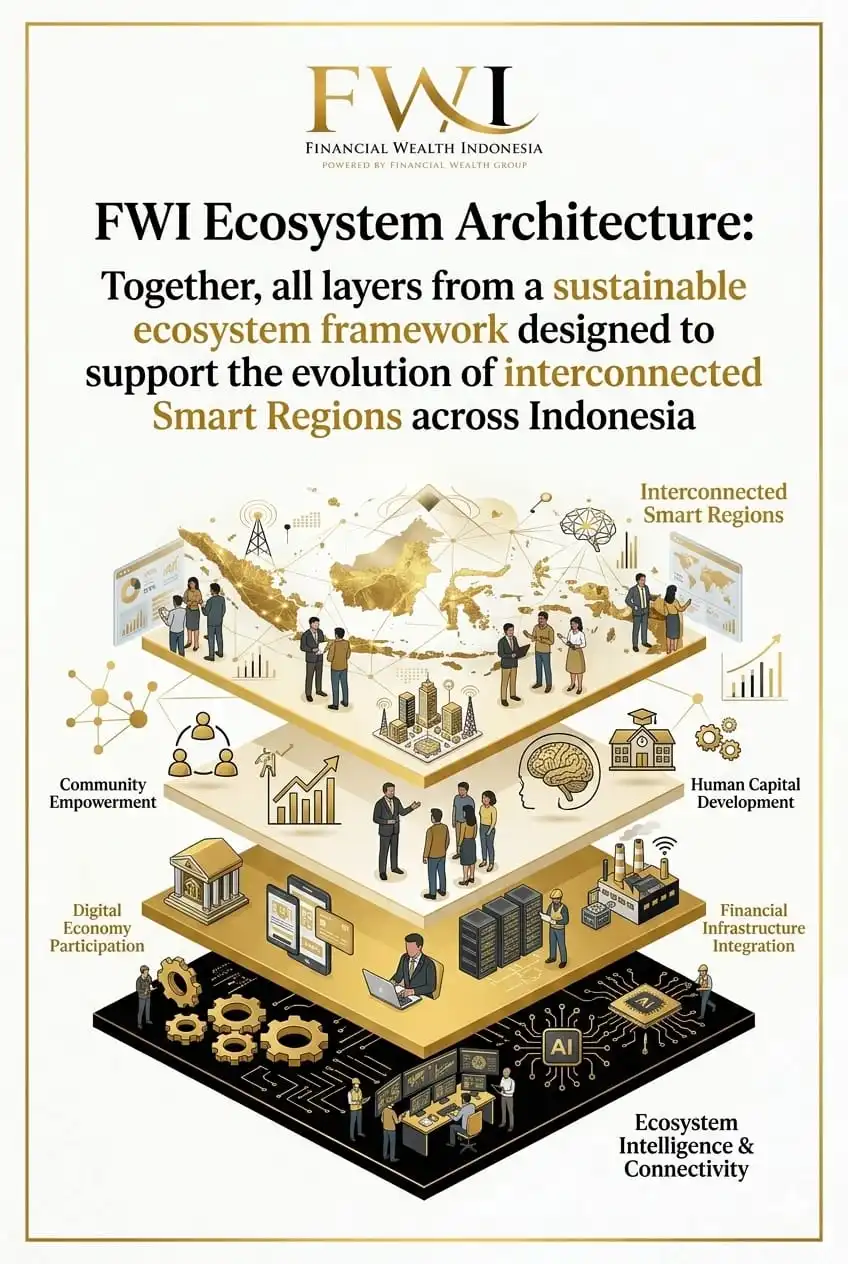
Government Layer
Supporting regional ecosystem coordination and public participation infrastructure.
Financial Infrastructure Layer
Connecting financial providers, payment ecosystems, and economic participation channels.
Digital Economy Layer
Enabling integrated digital participation across commerce, services, tourism, and communities.
Community & Human Capital Layer
Supporting inclusive regional empowerment and future-ready talent ecosystems.
Intelligence & Connectivity Layer
Integrating ecosystem intelligence, data infrastructure, and long-term regional connectivity.
SMART REGIONS INITIATIVE
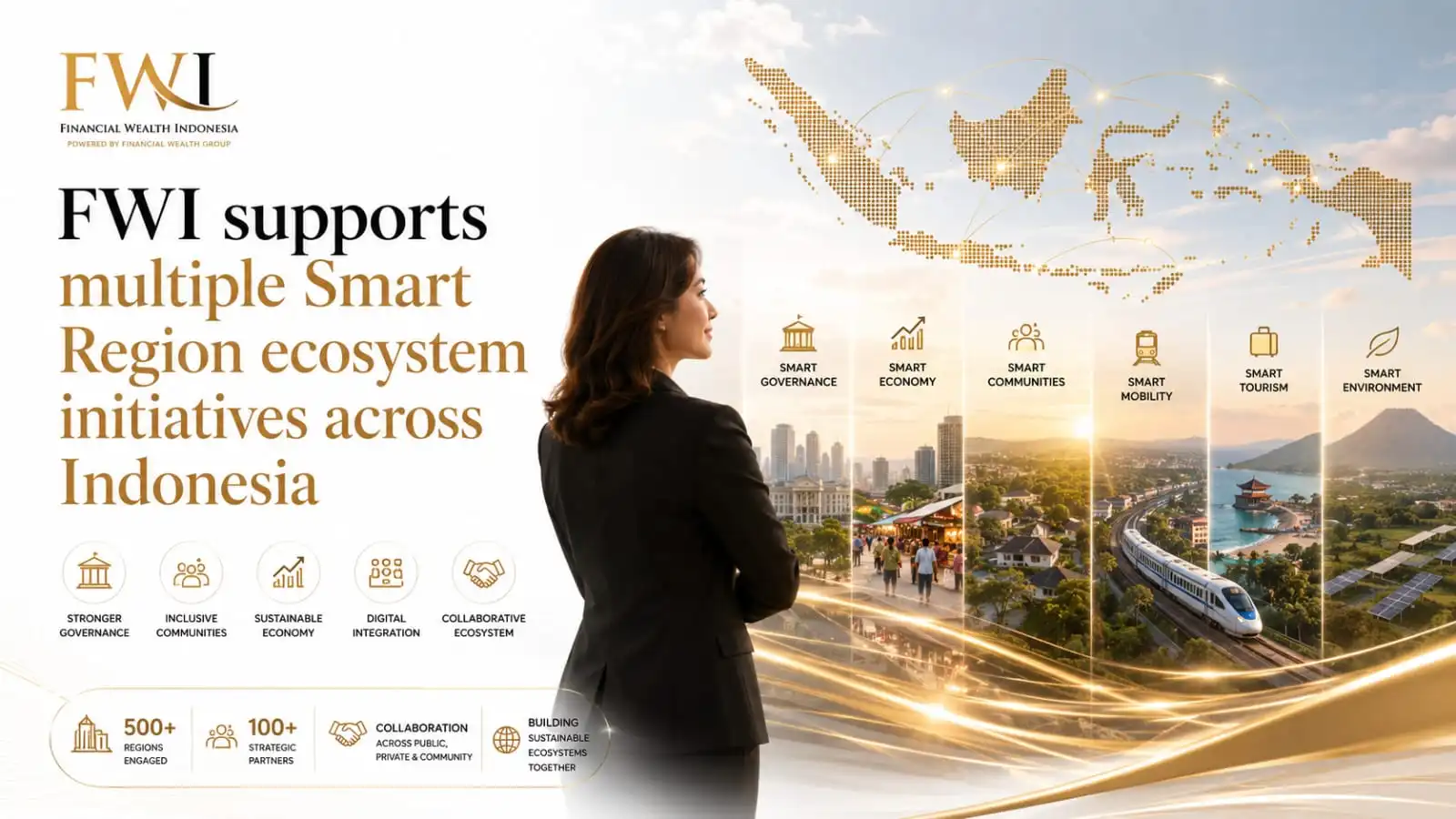
FWI supports the development of Smart Cities and Smart Regencies through integrated ecosystem infrastructure and regional collaboration frameworks.
Current ecosystem initiatives include multiple regional development movements across Indonesia, involving:
regional governments
financial providers
technology partners
local communities
and ecosystem stakeholders.
Rather than implementing isolated digital projects, FWI focuses on building interconnected regional ecosystems designed to strengthen regional participation, economic activity, and long-term sustainability.
The future of regional development may not be defined by standalone systems, but by how effectively ecosystems are connected.
STRATEGIC COLLABORATION
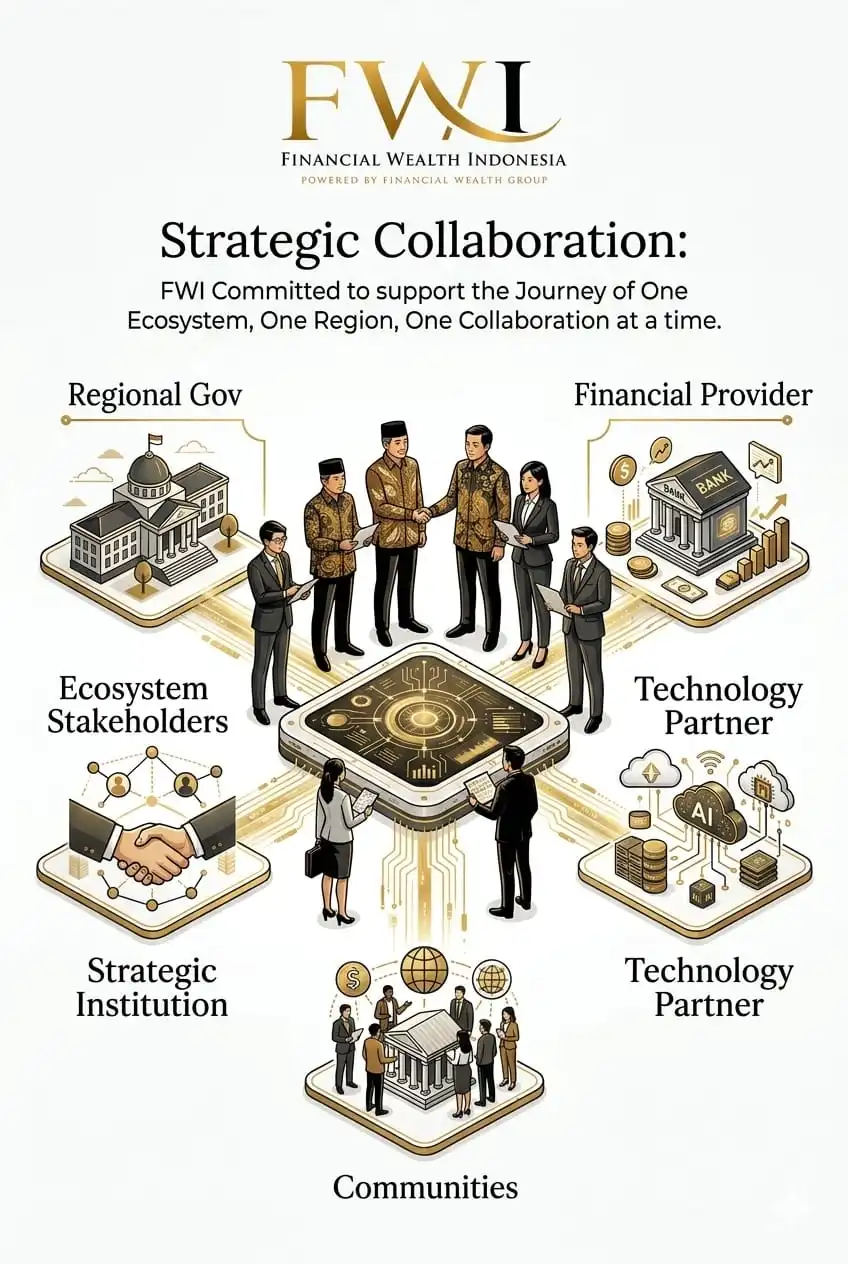
FWI believes sustainable transformation can only be achieved through long-term collaboration between institutions.
FWI works together with:
Regional Governments
Financial Providers
Technology Partners
Strategic Institutions
Communities
and Ecosystem Stakeholders
to help accelerate integrated regional development across Indonesia.
Through collaborative ecosystem participation, FWI aims to support a more connected, inclusive, and sustainable future for regional economies.
The future of Indonesia may not be built by isolated systems.
It may be built by interconnected regional ecosystems that move together intelligently, sustainably, and inclusively.
FWI is committed to supporting that journey — one ecosystem, one region, and one collaboration at a time.